


The role of UV radiation, hormones, and conscious skincare
Expert article by LUMEVIA
Author: Agnieszka Tumiel
Cosmetologist | Founder of LUMEVIA in Wrocław
Skin aging is a multidimensional process. Over many years of working with skin, I observe that Patients often focus primarily on visible changes — loss of firmness, wrinkles, hyperpigmentation, or changes in skin texture.
However, effective skin care begins much earlier — with understanding the mechanisms that lead to these changes.
This approach is also the foundation of Lumevia's work — a conscious look at the skin, its current condition, biological processes, lifestyle, environmental factors, and the individual needs of the Patient.
What truly determines the rate of skin aging?
We most often associate skin aging with the passage of time and genetics. These are natural processes that affect the appearance and function of the skin, but they are not the only factors responsible for the changes we observe with age.
The rate of skin aging does not depend solely on biological age. It is largely influenced by processes occurring within the body and daily environmental factors that affect skin structure over the years.
The most important of these include chronic exposure to UV radiation and hormonal changes. These are crucial for skin quality, collagen quantity, tissue elasticity, and the skin's ability to regenerate.
Photoaging is a particularly important process — meaning changes occurring under the influence of UV radiation. It is one of the most underestimated factors because it proceeds without clear warning signs for a long time.
The skin does not show every damage immediately. The consequences of daily exposure accumulate over the years.
UVA — radiation whose effects are not immediately visible
Ultraviolet radiation is divided into different ranges that affect the skin in different ways.
UVB is primarily responsible for reactions that are visible relatively quickly — skin redness, sunburn, and the tanning process.
UVA radiation works differently.
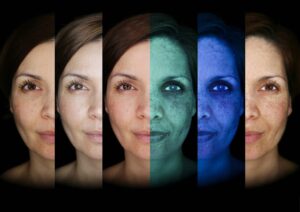
It does not have to cause redness or immediate discomfort, which is why many people do not perceive it as a threat. However, it penetrates deeper — into the dermis, where collagen and elastin fibers responsible for skin firmness, tension, and elasticity are located.
It is chronic exposure to UVA that contributes to the degradation of the skin's supportive structures and accelerates processes known as photoaging. One of the mechanisms of this process is the increased production of free radicals and the development of oxidative stress, which contributes to damage to skin cell structures and accelerates the degradation of collagen and elastin fibers.
Changes caused by UVA radiation are cumulative. Each exposure without adequate protection increases the burden on the skin's repair mechanisms.
Over time, as the activity of cells responsible for regeneration naturally decreases, the consequences of previous damage become more visible — loss of firmness appears, skin structure deteriorates, pigmentary changes occur, and its elasticity decreases.
Collagen — why is skin stimulation alone not enough?
Collagen is one of the most important supportive proteins in the skin. It is responsible for its density, elasticity, and proper structure.
Collagen production is the responsibility of fibroblasts — cells whose activity changes with age. In younger skin, regenerative processes are more efficient, while with advancing years, the natural ability of tissue remodeling gradually decreases.
Therefore, modern anti-aging therapies increasingly focus not only on improving the appearance of the skin but primarily on stimulating its natural regenerative mechanisms.
However, skin reconstruction and its protection must go hand in hand. One of the most common mistakes is focusing solely on collagen stimulation without simultaneously limiting the factors that lead to its degradation.
A patient can invest in advanced technologies and treatments that stimulate skin remodeling, but the lack of daily sun protection means that the skin remains exposed to mechanisms that damage its structure every day.
It is not enough to stimulate collagen production — it is equally important to create conditions that will protect the results of this remodeling.
An effective anti-aging strategy requires two directions of action: regeneration and limiting factors that accelerate skin aging.
SPF, antioxidation, and regeneration — conscious skincare
Sun protection is often underestimated because its action is primarily prophylactic.
It does not provide an immediate effect on the skin's appearance, but it influences its condition over the coming years.
Regular use of SPF protection is one of the most well-documented elements of photoaging prevention.
The basis of conscious skincare is:
– daily photoprotection limiting the impact of UV radiation on skin structures,
– antioxidant protection, including the use of ingredients such as vitamin C, supporting the skin in protecting against the effects of oxidative stress,
– active ingredients supporting skin renewal processes, including retinoids — some of the best-known substances used in skincare aimed at improving skin quality,
– regenerative care tailored to the current condition and needs of the skin.
In-office therapies stimulate skin remodeling, while daily care, photoprotection, and carefully selected active ingredients create an environment that supports its proper functioning.
Only the combination of these elements gives the skin the best conditions to maintain good quality, a healthy appearance, and natural renewal processes.
Hormones and their impact on skin quality
The second extremely important area affecting the aging process is hormonal changes.
A decrease in estrogen levels, which occurs during the perimenopausal and menopausal periods, is of particular importance.
Estrogens influence, among other things, collagen synthesis, hydration levels, elasticity, and the functioning of the skin's supportive structures.
Their reduction leads to changes in skin quality — a decrease in its density, firmness, and weakening of natural regenerative abilities.
A decrease in estrogen levels also affects the functioning of the skin's protective barrier, water balance, and the ability of tissues to maintain adequate hydration and regeneration.
Therefore, conscious anti-aging care is not just about reacting to visible changes.
It is primarily about understanding why these changes occur.
Lumevia's approach
At Lumevia, we do not view skin aging as a process to be fought. It is a natural part of the body's biology, requiring understanding, respect, and conscious support.
Our goal is not to change natural appearance, but to care for skin quality, support its functions, and maintain harmonious results consistent with the Patient's individual characteristics.
We do not look at the skin solely through the prism of a single problem or treatment.
Every skin has its story — resulting from biological age, genetic predispositions, hormonal balance, lifestyle, exposure to external factors, and previous care.
Therefore, the basis of our work is diagnosis, analysis of skin needs, and individual therapy planning.
We combine cosmetological knowledge, advanced medical technologies, biostimulating therapies, and home care to support the natural regenerative mechanisms of the skin and care for its quality in a conscious and long-term manner.

About the author
For 19 years, she has specialized in medical cosmetology and therapies aimed at improving the health, quality, and condition of the skin.
In her work, she combines skin diagnostics, advanced medical technologies, knowledge of aesthetic dermatology, and a holistic approach to aging processes and longevity.
Published Lumevia articles are based on experience working with Patients, cosmetological knowledge, and current information regarding skin function, aging processes, regeneration, and conscious care.
